
What’s the Difference?
If you have been told your vehicle needs ECU cloning, coding, programming or virginizing, the terminology can quickly become confusing.
The simplest way to think about it is this: cloning copies relevant data from one control unit to another, coding configures a module for the vehicle, programming writes software or data, and virginizing resets a supported module so it can be adapted again.
The correct process depends on the vehicle, the control unit, its condition and the security data stored within it. A replacement ECU that physically fits is not necessarily ready to use.
The Four Terms Explained Simply
- ECU cloning: Copies relevant data from an original control unit to a compatible replacement.
- ECU coding: Configures a module for the vehicle's specification and installed equipment.
- ECU programming: Writes software, firmware or other required data to a control unit.
- Virginizing: Resets certain stored information so a supported module can be adapted to another vehicle.
These processes can overlap, but they are not interchangeable.
A job may require one process, several of them, or a completely different approach depending on the vehicle.
What Is ECU Cloning?
ECU cloning involves transferring relevant data from an original electronic control unit to a compatible replacement.
The aim is usually to make the replacement unit carry the information required to operate correctly within the vehicle.
Depending on the ECU, that data may include:
- Software
- Calibration data
- Configuration information
- Vehicle identification data
- Immobiliser or security information
Cloning is particularly useful when the original ECU is failing electronically but its data can still be read.
For example, if an engine ECU has a hardware fault but its memory remains accessible, it may be possible to transfer the necessary information into a suitable donor unit.
That can sometimes avoid having to configure every element of the replacement from scratch.
What Is ECU Coding?
ECU coding usually means configuring a control module so it matches the vehicle and its installed equipment.
A replacement module may already contain functioning software, but it might not know how the particular vehicle is configured.
Coding can tell the module which features, systems or vehicle options it needs to work with.
This is common when replacing or retrofitting electronic components.
For more complex module work, Lehane Autos' ECU programming and vehicle coding services cover supported programming, coding, adaptations and replacement control-unit integration.
What Is ECU Programming?
Programming generally means writing software, firmware or other data into a control unit.
This may be needed when:
- Installing a replacement ECU
- Updating control-unit software
- Reprogramming a module after repair
- Preparing a new control unit for the vehicle
- Completing certain manufacturer procedures
Programming is more than clearing fault codes.
A diagnostic scan reads information from the vehicle. Programming changes what is stored inside a control module.
View Programming ServicesWhat Does Virginizing an ECU Mean?
Virginizing, sometimes described as resetting or preparing a module, means returning certain stored data to a state where the control unit can potentially be adapted to another vehicle.
It does not mean every ECU can simply be wiped and reused.
Depending on the module, the process may involve resetting:
- Vehicle identification information
- Adaptation data
- Configuration information
- Immobiliser-related information
- Other stored vehicle-specific data
Whether this is possible depends heavily on the control unit.
Some modules can be reset relatively cleanly. Others contain protected or one-time security data, while some cannot be economically or safely reused at all.
ECU Cloning vs Coding vs Programming
The easiest way to understand the difference is by looking at what happens to the data.
One replacement ECU might only need programming and coding.
Another might be easier to clone.
A third may need resetting before any adaptation can take place.
This is why the correct process cannot usually be chosen from the part number alone.
Why Used ECUs Are Not Always Plug-and-Play
One of the most common misunderstandings with replacement vehicle electronics is assuming that a matching used part can simply be installed.
Modern control modules may contain information linked to the original vehicle.
This can include:
- VIN data
- Immobiliser information
- Security identities
- Configuration
- Software versions
- Component identities
- Learned adaptations
A donor unit can therefore be mechanically identical and still be electronically unsuitable.
Even two vehicles of the same model and year can use different hardware revisions or software versions.
Before buying a second-hand ECU or module, it is often worth checking whether it can actually be cloned, programmed, coded or reset.
Why VIN & Component Identity Matter
A Vehicle Identification Number is only one part of the electronic identity stored within modern vehicles.
Control modules can also contain component-specific identification and security information.
These electronic identities help the vehicle determine whether modules belong within the system and whether they are authorised to communicate.
This becomes particularly important with:
- Engine ECUs
- Body control modules
- Immobiliser modules
- Instrument clusters
- Gateways
- Security-related electronics
Changing one module may therefore affect communication with several others.
That is why replacement module work often requires an understanding of the whole vehicle network rather than simply the component being changed.
Immobiliser & Security Data Can Change the Job
Security data is one of the biggest reasons ECU replacement can become more complicated.
Modern vehicles may link the engine ECU to several other components, such as the immobiliser, body control module, key system or gateway.
If the security information does not match, the replacement ECU may communicate normally but the engine may still refuse to start.
Depending on the vehicle, solving this may involve:
- Cloning security information
- Immobiliser synchronisation
- Coding
- Adaptation
- Resetting compatible modules
- Manufacturer-specific programming
The exact method varies significantly between manufacturers and generations.
Lehane Autos combines this type of work with specialist vehicle electronics and retrofit services where supported.
When Is Cloning Better Than Coding?
Cloning can be useful when the original ECU already contains everything the vehicle needs and the main problem is hardware failure.
For example, cloning may make sense when:
- The original module's data remains readable
- A compatible donor module is available
- Vehicle-specific security data needs to be retained
- Recreating the original configuration would be unnecessarily complex
- The replacement can accept the relevant memory data
In those situations, transferring known working data can sometimes be more practical than rebuilding the replacement module configuration from the beginning.
When ECU Cloning May Not Be Possible
Cloning is not always the answer.
It may not be possible or appropriate if:
- The original ECU memory is badly damaged
- Critical data cannot be read
- The donor hardware is incompatible
- Software versions differ significantly
- Security data is protected
- The module uses one-time programming
- Manufacturer-specific restrictions prevent reuse
- A replacement requires online manufacturer programming instead
A badly damaged original ECU can make cloning particularly difficult because the information needed for the replacement may no longer be accessible.
In that situation, alternative programming or adaptation methods may need to be considered.
Does the Whole Vehicle Need to Be Present?
Not always.
Some ECU and module work can be carried out with the control unit removed from the vehicle.
That may include certain:
- Data extraction jobs
- ECU cloning
- Memory transfer
- Module preparation
- File-based programming
- Supported reset or virginizing work
Other procedures require the complete vehicle because several modules need to communicate with one another.
The vehicle may also be required for:
- Immobiliser synchronisation
- Manufacturer online programming
- Coding across several modules
- Final adaptations
- Functional testing
- Security-related procedures
We offer remote and postal vehicle electronics services where the job can safely be completed without having the whole vehicle at the workshop.
What Can Be Sent by Post?
A postal service can make sense when the work can be completed directly on an ECU or control module.
The exact requirements vary, but a technician may need:
- The original module
- The replacement module
- Vehicle details
- Part numbers
- Details of the fault or requested work
Some jobs only require a module.
Others require both original and donor units.
And some cannot be completed properly without the vehicle itself.
Checking this before removing or posting components can save considerable time.
Why Specialist Equipment Matters
Modern control units do not all store or protect data in the same way.
Access can vary depending on:
- Processor type
- Memory architecture
- Security level
- Vehicle manufacturer
- ECU generation
- Software version
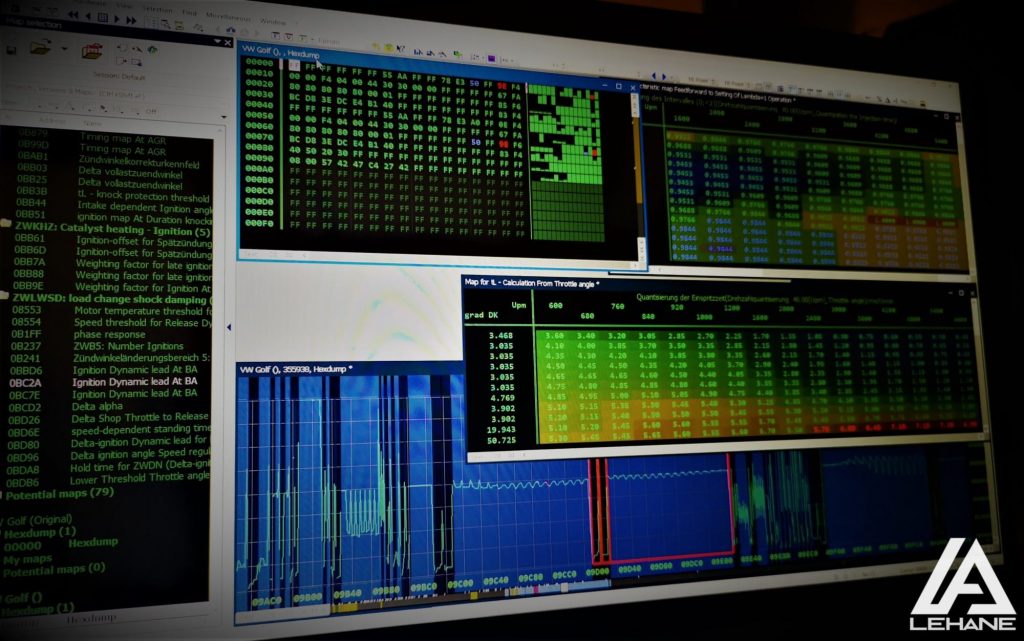
Some modules can be accessed through the vehicle's diagnostic connection.
Others require bench programming or direct access to the control unit.
More protected ECUs may need specialist methods before their data can be read or written.
Lehane Autos' work with newer Bosch MD1 and MG1 ECU systems is one example of how access methods change as ECU security develops.
Correct equipment is only part of the job. The technician also needs to understand what data should be changed and, equally importantly, what should be left untouched.
Common ECU Replacement Mistakes
Several problems can be avoided by checking the electronic requirements before replacing a module.
Buying the Wrong Donor
A similar part number does not necessarily mean two modules are electronically compatible.
Assuming Plug-and-Play
Many modern ECUs contain vehicle-specific configuration or security data.
Discarding the Original
Even a faulty ECU may contain valuable information required to prepare its replacement.
Clearing Codes First
Deleting fault codes does not repair a failed module or resolve a programming problem.
Programming Without Diagnosis
Replacing or programming an ECU before identifying why the original failed can create a second problem rather than fixing the first.
If the cause of the fault is uncertain, proper vehicle diagnostics and fault finding should usually come before replacement programming.
Which Service Do You Actually Need?
A useful rule of thumb is:
Cloning is about copying.
Coding is about configuration.
Programming is about writing software or data.
Virginizing is about resetting supported vehicle-specific information.
But real vehicles do not always fit neatly into one category.
A replacement module can require cloning, programming and coding as part of the same repair.
The safest approach is usually to identify:
- What failed
- Which module is fitted
- Whether its data can still be read
- What replacement is available
- What security or vehicle-specific information is involved
Only then can the appropriate process be confirmed.
FAQs
Is ECU Cloning the Same as Programming?
No. Cloning usually transfers relevant data from one ECU to another. Programming is a broader term for writing software, firmware or data to a control unit.
Can Any ECU Be Cloned?
No. Whether cloning is possible depends on the ECU, available data, hardware compatibility and security architecture.
Can a Second-Hand ECU Be Reused?
Sometimes. A used ECU may require cloning, coding, programming, resetting or security synchronisation before it can work in another vehicle.
Does ECU Coding Change the Software?
Not necessarily. Coding commonly changes configuration rather than replacing the underlying software, although procedures vary between manufacturers.
Can an ECU Be Cloned by Post?
Some ECU cloning and module-level work can be completed without the vehicle, provided the required units and data are available. Other jobs require the complete vehicle.
Should I Buy a Donor ECU First?
It is often better to check compatibility before purchasing one. Part number, hardware, software and security differences can determine whether a donor module is usable.
Check What Your ECU Actually Needs Before Replacing It
ECU cloning, coding, programming and virginizing solve different electronic problems. Choosing the correct method depends on the original module, the replacement and the vehicle systems connected to them.
If you are dealing with a failed ECU, a donor module or an electronic component that needs adapting, it is worth establishing what the job requires before buying parts or removing modules.
Lehane Autos provides specialist ECU programming and vehicle coding, remote ECU and module services, electronics and retrofit support and trade services for automotive businesses.
